
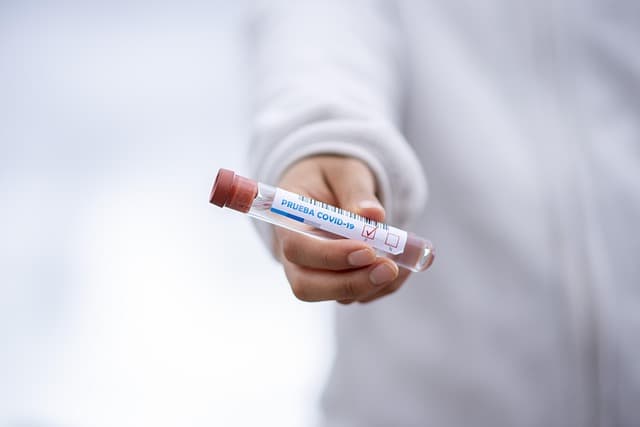
Four types of tests can help detect coronavirus infection in the human body. These are PCR-diagnostics (polymerase chain reaction method), ELISA tests (enzyme-linked immunosorbent assay) for antibodies, express tests for antibodies and express tests for antigen, which detect the virus using immunochromatographic method.
The most popular way to confirm the presence of infection is PCR testing. For this diagnosis, a swab from the nose and throat is taken. Antibody tests (lgG, lgA or lgM) are used to find out whether you have already been infected or to assess the immune response of the body to the course of the disease. Venous blood is used for these tests. They are considered an adjunctive diagnostic test. A less reliable alternative to laboratory tests is rapid diagnostics. A rapid test for antigen is performed with a nasal swab, for antibodies – blood from the finger.
Depending on the laboratories’ capabilities, the results of a rapid antigen test, as well as a rapid antibody test, can be obtained in 15 minutes. The turnaround time for a PCR test is 1-2 days. Patients can get the results of antibody tests in 2-3 days.
Is there a risk of contracting coronavirus while waiting in line for tests?
According to the doctor, the risk of contracting coronavirus in the queue for tests is no greater than in other public places. All patients are asked to keep a certain distance, laboratories have hand disinfectants, closed-type germicidal lamps, and are cleaned. All patients are accepted by the laboratory as potentially infected, there is no separation of queues, but the main rule remains: patients must wear masks and keep a certain distance. If a sick person came into the blood donation room before you, but wearing a mask, and you were not in the room for more than 15 minutes, not in close contact, the probability of getting infected with covida in the laboratory is very low.
Why will the COVID-19 test give a negative result on the first day of fever?
On the first day of fever, the COVID-19 test may be a false negative because the body has not yet developed enough antibodies to the virus or not enough of the virus’ causative RNA to detect it.
On what day after recovery should I retest for COVID-19?
According to MOH regulations and WHO recommendations, a repeat test is not necessary. If 14 days have passed from the onset of the disease and the patient has no clinical signs of Covid-19 within the last three days, the patient can be considered to have recovered. The causative RNA may be detected some time after the patient has recovered, but these RNA fragments are not capable of replication, so after the 10th day of clinical manifestations, the causative coronavirus is considered by infectious disease specialists to be incapable of infection and safe for others. In this case, a person can really get a positive PCR test.
The head of the laboratory notes that the PCR-test after recovery is uninformative. In this case, it is better to do immunoenzyme tests to detect antibodies to assess the body’s immune response to the course of the disease. But not earlier than 5-7 days from the onset of symptoms – to detect IgM antibodies, and after 10 days – to detect IgA antibodies. The test for IgG antibodies is done mainly at the patient’s request, to find out whether the person has had the disease before. These antibodies can be detected in the blood from 2-3 weeks of illness until 3-6 months after infection. Immunoglobulin G shows that a person has had an active disease process for a certain period of time, but is currently healthy. It is worth remembering that it is still being studied how many antibodies can be found in the body of a person who has been infected with Covid-19.